

Your Professional Water Softening System Equipment Supplier
Audlong supplies water softening system equipment for industrial water treatment, beverage production, boiler feedwater pretreatment, and other process water applications. Product configurations can be selected according to raw water hardness, water demand, operating conditions, and the requirements of downstream equipment.
Our water softening solutions can include ion exchange resin vessels, automatic control valves, brine tanks, regeneration controls, and associated piping and instrumentation, depending on the project specification.
From single-vessel softeners to duplex systems for more continuous water supply, we help industrial buyers identify suitable configurations for their water treatment requirements.
-
![Skid Mounted Water Softening System Equipment]() Skid Mounted Water Softening System EquipmentSkid Mounted Water Softening System Equipment removes calcium and magnesium hardness from feed water through ion exchange. The system is deployed where hard water can cause scale formation in...
-
![Duplex Water Softener System Equipment]() Duplex Water Softener System EquipmentDuplex Water Softener System Equipment utilizes a dual-vessel ion-exchange configuration to continuously reduce water hardness by removing calcium and magnesium ions.
-
![Food And Beverage Water Softening System Equipment]() Food And Beverage Water Softening System EquipmentThe Food and Beverage Water Softening System is engineered to control mineral scale formation in industrial water networks, steam boilers, heat exchangers, and reverse osmosis (RO) pretreatment lines.
-
![Boiler Feed Water Softening System Equipment]() Boiler Feed Water Softening System EquipmentAn industrial boiler feedwater softening system relies on sodium-cycle cation exchange to reduce raw water hardness prior to boiler entry. Hardness ions (calcium and magnesium) are exchanged for...
-
![Reverse Osmosis Pretreatment Water Softener Equipment]() Reverse Osmosis Pretreatment Water Softener EquipmentReverse Osmosis Pretreatment Water Softener Equipment reduces feed water hardness prior to the reverse osmosis (RO) membrane stage. By utilizing sodium-cycle strong acid cation exchange resin, the...
-
![Industrial Water Softening System Equipment]() Industrial Water Softening System EquipmentIndustrial water softening systems reduce calcium and magnesium hardness through ion exchange, controlling scale formation in industrial water systems and process equipment.


Technical Parameters & Selection Guidelines
|
Parameter |
Information Required for Sourcing |
|
Raw Water Source |
Municipal supply, deep well groundwater, surface water, etc. |
|
Total Hardness |
Measured numerical value and measurement units (mg/L, ppm, gpg) |
|
Flow Rate |
Normal operating flow rate and peak flow demand (m3/h or GPM) |
|
Daily Consumption |
Estimated total volume treated per operating cycle or day |
|
Outlet Hardness |
Target residual hardness limit required by process |
|
Regeneration Control |
Time-clock delayed, metered demand, or external PLC trigger |
|
Utilities & Space |
Power supply, inlet pressure, drain proximity, and footprint limits |
Why Choose Us
In-House Production & Quality Control
Equipment fabrication is managed under strict manufacturing protocols, from pressure vessel assembly to structural manifold welding, ensuring structural integrity and reliable field performance under heavy industrial demands.
Factory Acceptance Testing (FAT)
Every system undergoes rigorous pre-shipment testing, including pressure resistance verification, automatic valve actuation checks, and electrical control inspections to guarantee operational readiness before site installation.
Material Traceability & Component Standards
Systems are built using verified industrial-grade components, including corrosion-resistant pressure vessels, certified control valves, high-purity cation exchange resins, and heavy-duty polyethylene brine tanks. Component datasheets and material compliance records are available for project review.
Engineering & Custom Integration Support
Technical teams provide comprehensive support ranging from raw water analysis interpretation and hydraulic sizing to custom skid assembly and piping layout design, ensuring seamless integration with plant infrastructure.
Core System Configurations

1. Automatic Water Softener System
Equipped with electronic or electromechanical control valves that automate both the service run and the resin regeneration cycles. Regeneration triggers can be programmed based on elapsed time or measured volumetric throughput.
Application Fit: Facilities requiring automated operation with minimal operator intervention.
Key Design Factors: Actual feed hardness, daily volume, peak flow rates, and available utility drain lines.
2. Single-Tank Water Softening System
A cost-effective configuration utilizing a single resin vessel. It handles standard industrial loads where periodic regeneration downtime can be accommodated within the facility's operating schedule.
Application Fit: Operations with non-continuous shifts or scheduled downtime windows.
Operational Note: The vessel is taken offline during regeneration; un-softened water or alternative backup arrangements must be evaluated if continuous output is mandatory.
3. Duplex Water Softening System (Alternating / Parallel)
Features two resin vessels operating in a coordinated configuration. While one vessel is actively in service, the other undergoes regeneration or remains on standby.
Application Fit: Continuous production facilities operating around the clock that cannot tolerate any interruption in soft water supply.
4. Heavy-Duty Industrial Water Softener
Custom-engineered arrangements utilizing large-diameter pressure vessels, multi-valve distribution manifolds, and high-capacity salt storage systems designed for massive daily grain removal in heavy industrial environments.

Typical Industrial Applications
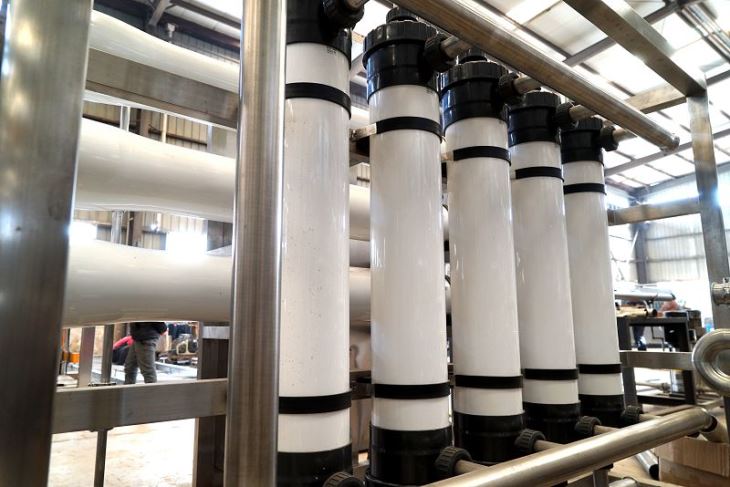
Reverse Osmosis (RO) Pretreatment: Removing hardness upstream prevents calcium sulfate and calcium carbonate scale buildup on spiral-wound RO membranes, preserving membrane flux and extending operating lifespan. (Note: Softening does not replace media filtration or downstream demineralization).
Beverage Production & Bottled Water Plants: Pre-treating process water to meet raw water standards for washing, rinsing, and dilution phases, complying with food-grade hygiene and safety protocols.
Boiler Feedwater Pretreatment: Protecting low- and high-pressure steam boilers from internal scaling, reducing thermal transfer loss and catastrophic tube failure risks.
Heat Exchangers & Industrial Cooling Makeup: Mitigating scaling in closed and open-loop cooling systems and heat-transfer equipment.
Operational & Regeneration Considerations
Regeneration Wastewater Discharge: Ensure facility drainage infrastructure can handle high-salinity brine rinse discharge volumes during regeneration cycles.
Inlet Pressure Stability: Maintain consistent operating pressure (typically 0.2 to 0.6 MPa) across the valve inlet to prevent hydraulic cavitation and flow starvation.
Resin Longevity: Service life depends on feed water chlorine/chloramines levels, turbidity, and iron content. Pre-filtration (such as activated carbon or multimedia filters) may be required if oxidants or suspended solids are present.
Salt Consumption Management: Calculate projected salt usage based on grain capacity and regeneration frequency to optimize ongoing operational expenditures.
Frequently Asked Questions
We're well-known as one of the leading water softening system equipment manufacturers and suppliers in China for our quality products and competitive price. Please feel free to buy or wholesale water softening system equipment in stock here from our factory. Contact us for quotation.
Popular Products


