

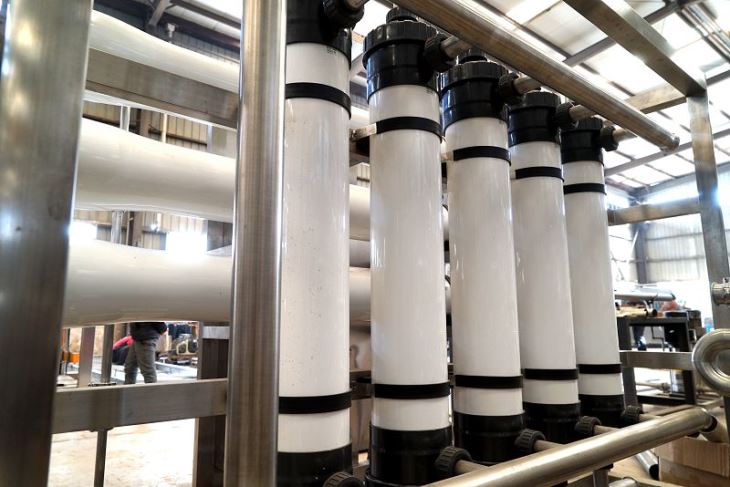
Skid Mounted Water Softening System Equipment removes calcium and magnesium hardness from feed water through ion exchange. The system is deployed where hard water can cause scale formation in boilers, heat exchangers, process piping, and reverse osmosis pretreatment equipment.
The softening unit is assembled on a robust structural steel skid to simplify equipment positioning, system integration, and site installation. Depending on the required capacity and operating conditions, the configuration includes softener pressure vessels, high-capacity ion exchange resin, a corrosion-resistant brine tank, automatic or manual regeneration valves, interconnecting pipework, and an integrated control system.
Each proposed configuration is matched precisely to the raw water analysis, operating flow rate, required outlet hardness, installation constraints, and project scope.
Technical Selection Parameters
|
Selection Parameter |
Technical Requirement to Confirm |
|
Feed Water Hardness |
Total hardness expressed in mg/L (ppm) as CaCO3 or equivalent units. |
|
Design Flow Rate |
Normal continuous operating flow rate and short-term peak demand (m3/h or GPM). |
|
Target Outlet Hardness |
Maximum allowable residual hardness at the system effluent. |
|
Daily Water Demand |
Total volume required per day and operational shift schedule. |
|
Resin Exchange Capacity |
Calculated treatment volume between regeneration cycles. |
|
Regeneration Arrangement |
Single vessel, duplex alternating, or parallel multi-vessel configuration. |
|
Operating Pressure & Temp |
Available inlet pressure, pressure drop limits, and water temperature range. |
|
Utility Requirements |
Salt supply type, regeneration wastewater drain capacity, and electrical supply. |
Where Is a Skid Mounted Water Softening System Used?
The system is suitable for industrial processes that require reduced water hardness before water enters downstream equipment or sensitive production lines.
Boiler Feed Water Pretreatment: Hardness removal helps mitigate calcium and magnesium scale formation in steam and hot water boiler feed systems. Final water quality requirements depend on boiler type, operating pressure, and applicable regulatory standards. Additional polishing or pretreatment may be required based on water chemistry.
Reverse Osmosis (RO) Pretreatment: A water softener reduces the risk of mineral scaling on RO membrane surfaces, protecting membrane lifespan and maintaining system permeability. Suitability depends on feed water chemistry and overall pretreatment design (such as media filtration or chemical dosing).
Cooling Tower Makeup Water: Softening helps control hardness-related mineral deposits in open and closed cooling loop systems. The appropriate strategy depends on makeup water quality, cycles of concentration, and corrosion control requirements.
Food and Beverage Processing: Industrial softening systems supply conditioned utility and non-product contact water for beverage plants, food factories, and processing facilities. Where water is used as an ingredient or directly contacts products, additional hygienic and purification steps must be evaluated separately.
Industrial Process Water: Facilities utilizing heated water, heat exchangers, industrial washing machines, and other hardness-sensitive equipment rely on softening as part of their core water treatment train.
How Does the Water Softening System Work?
A conventional sodium-cycle industrial water softener utilizes strong acid cation exchange resin to reduce mineral hardness.
Service Operation: Raw feed water passes downward through the resin bed. Calcium and magnesium ions are exchanged for sodium ions, and conditioned soft water is discharged through the outlet distribution system.
Regeneration Sequence: When the resin's exchange capacity is exhausted, it is regenerated using a sodium chloride (NaCl) brine solution. The automated or manual sequence typically encompasses backwashing, brining, slow rinsing, fast rinsing, and return to service.
Continuous Supply Management: For applications requiring uninterrupted soft water 24/7, duplex alternating (twin-vessel) or multi-vessel configurations are implemented to ensure continuous flow while one vessel undergoes regeneration.
Quality Control & Factory Testing
Industrial water treatment assemblies undergo rigorous quality verification before dispatch:
Pressure & Leak Testing
Hydrostatic pressure testing of vessels, valve nests, and interconnecting pipework to verify structural integrity and prevent leakage.
Electrical & Functional Check
Verification of control panel wiring, valve actuator response, and automated regeneration sequencing prior to shipment.
Documentation Package
Delivery includes general arrangement drawings, process flow diagrams, electrical schematics, component manuals, and factory test reports.
FAQ
Q: What does a skid-mounted water softening system include?
A: A standard package includes pressure vessels, ion exchange resin, a brine tank, control valves, interconnecting piping, and a structural steel base frame. Raw water pumps, booster pumps, and pretreatment filters are supplied based on specific project requirements.
Q: Is a skid-mounted water softener suitable for RO pretreatment?
A: Yes, when calcium and magnesium hardness present a scaling risk to reverse osmosis membranes. However, feed water chemistry and overall pretreatment design must be thoroughly analyzed to verify if softening alone is sufficient or if chemical antiscalant dosing is also needed.
Q: Can the system provide softened water continuously?
A: Yes. By deploying a duplex alternating (twin-tank) configuration, one vessel remains in service while the other is regenerating or in standby, ensuring an uninterrupted supply of soft water.
Q: Does water softening remove Total Dissolved Solids (TDS)?
A: No. Conventional sodium-cycle softening exchanges hardness minerals for sodium ions; it does not reduce the total salt content or TDS of the water. For TDS reduction, reverse osmosis or demineralization systems are required.
Hot Tags: skid mounted water softening system equipment, China skid mounted water softening system equipment manufacturers, suppliers, factory


