

Your Professional Industrial Water Filtration System Equipment Supplier
Industrial water filtration systems remove suspended solids, sediment and other particulate contaminants from water used in manufacturing, process operations and water treatment plants. Audlong provides water treatment equipment and system solutions for industrial and commercial projects, with filtration requirements assessed according to source water quality, required flow rate and downstream treatment processes.
Our industrial water filtration equipment range can cover filtration units and supporting systems for raw water pretreatment, process water filtration, cooling water treatment and pretreatment before reverse osmosis (RO), subject to project requirements and confirmed equipment availability.
-
![Industrial Water Pretreatment System Equipment]() Industrial Water Pretreatment System EquipmentIndustrial water pretreatment systems remove suspended solids, colloidal particles, free chlorine, hardness ions, and organic impurities from raw water sources prior to entering high-purity or...
-
![Industrial Raw Water Filtration System Equipment]() Industrial Raw Water Filtration System EquipmentIndustrial raw water filtration systems remove suspended solids, sand, sediment, rust particles, and filterable impurities from source water before it enters downstream treatment processes.
-
![Industrial Process Water Filtration System Equipment]() Industrial Process Water Filtration System EquipmentAn industrial process water filtration system removes suspended solids, sediment, rust particles, and filterable impurities from water utilized in manufacturing operations.
-
![Industrial Cooling Tower Water Filtration System Equipment]() Industrial Cooling Tower Water Filtration System EquipmentIndustrial Cooling Tower Water Filtration System Equipment removes suspended solids, sediment, and particulate contaminants from recirculating cooling water. It controls particulate accumulation...
-
![Industrial Screen Filter System Equipment]() Industrial Screen Filter System EquipmentIndustrial screen filter systems remove suspended solids, sediment, rust particles, and other mechanical impurities from water through a physical screening process. Water passes through a...
-
![Industrial Disc Filter System Equipment]() Industrial Disc Filter System EquipmentIndustrial Disc Filter System Equipment removes suspended solids from raw water and industrial process water through a compressed stack of precision-grooved filter discs. As water flows through...


Technical Selection Parameters
|
Selection Factor |
Engineering Specification Required |
Impact on System Design |
|
Water Source |
Well water, surface water, process effluent, or cooling water |
Determines contaminant profile, organic load, and material selection. |
|
Flow Rate |
Normal and peak flow rates (cubic meters per hour) |
Dictates vessel sizing, manifold dimensions, and pump matching. |
|
Suspended Solids |
Total Suspended Solids (TSS), turbidity (NTU), particle size distribution |
Defines filter type, media selection, and solids-holding capacity. |
|
Filtration Rating |
Target micron rating or downstream equipment specification |
Establishes barrier precision and separation efficiency. |
|
Operating Pressure |
Inlet pressure, design pressure, and allowable pressure drop |
Governs mechanical strength, pipe rating, and hydraulic design. |
|
Water Chemistry |
pH, temperature, total dissolved solids (TDS), corrosive ions |
Determines vessel and internal wetted parts material. |
|
Cleaning Mechanism |
Manual cleaning, automatic backwashing, or cartridge replacement |
Influences operational automation, labor requirements, and utility consumption. |
Typical Industrial Applications

Raw Water Pretreatment: Reducing silt, sand, and organic suspended solids from surface water or well water before primary treatment stages.
Reverse Osmosis (RO) Pretreatment: Controlling particulate fouling and protecting membrane surfaces. Note: Particulate filtration reduces suspended solids but does not remove dissolved minerals; final RO protection requires complete feed water analysis review.
Industrial Process Water: Maintaining strict particulate limits in manufacturing and washing loops to prevent nozzle clogging and equipment wear.
Cooling Tower Recirculating Water: Managing suspended solids accumulation in open or closed cooling loops via side-stream filtration arrangements.
Material & Construction Standards
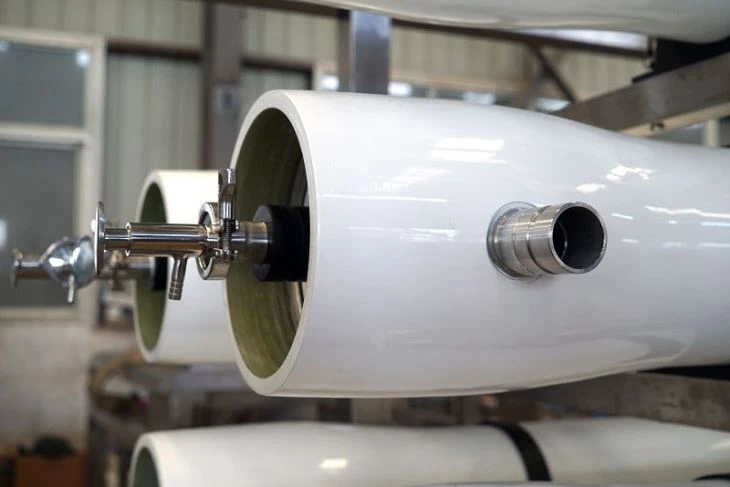
Industrial durability depends heavily on metallurgy, pressure vessel design, and corrosion protection. Standard equipment construction specifications include:

Vessel Materials
Carbon steel with specialized internal/external anti-corrosion coatings, stainless steel (SS304, SS316L), or duplex stainless steel for aggressive water chemistry.

Internal Internals
Wedge-wire screens, distribution hubs, and header-lateral assemblies designed for uniform flow distribution and structural rigidity under pressure surges.

Valves & Automation
Heavy-duty butterfly valves, pneumatic or electric actuation, and corrosion-resistant control components.
System Configuration & Integration Scope
Industrial filtration equipment can operate as standalone units or as integrated stages within broader fluid treatment trains. A comprehensive equipment supply package typically incorporates:
- Pressure vessels or housings fabricated to industrial standards.
- Internal distribution headers, screens, discs, filter media, or replacement cartridges.
- Inlet, outlet, and drain isolation valves.
- Automatic backwash valve manifolds (where applicable).
- Pressure gauges and differential pressure transmitters for automated cleaning triggers.
- Electrical control panels (PLC-based automation with HMI interface) for automated system control.
- Skid-mounted pre-piped and pre-wired assemblies for simplified on-site installation.
Maintenance & Operational Guidelines
Routine Inspection Protocols
Operators should regularly monitor inlet and outlet pressure gauges to track differential pressure accumulation. Visual checks of automatic valves, pneumatic actuators, electrical control panels, and drainage discharge lines should be performed weekly to ensure proper cleaning cycles and prevent unexpected downtime.
Filter Element and Media Replacement Intervals
Screen and disc elements require inspection for wear, scaling, or structural damage during scheduled plant maintenance shutdowns. Cartridge elements must be replaced when differential pressure exceeds manufacturer limits and backwashing or cleaning no longer restores flow capacity. Granular multimedia beds require periodic backwash expansion adjustments and occasional media replenishment or replacement based on long-term wear and attrition.
FAQ
We're well-known as one of the leading industrial water filtration system equipment manufacturers and suppliers in China for our quality products and competitive price. Please feel free to buy or wholesale industrial water filtration system equipment in stock here from our factory. Contact us for quotation.
Popular Products


