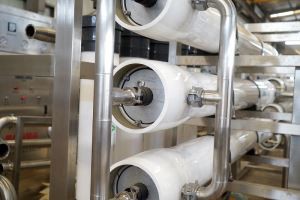


The Food and Beverage Water Softening System is engineered to control mineral scale formation in industrial water networks, steam boilers, heat exchangers, and reverse osmosis (RO) pretreatment lines. By utilizing high-capacity strong-acid cation-exchange resin, the system effectively reduces total water hardness by exchanging calcium (Ca2+) and magnesium (Mg2+) ions for sodium (Na+) ions.
In beverage production and food processing plants, proper hardness control protects downstream thermal and separation equipment from mineral scaling, maintaining thermal efficiency, protecting membrane integrity, and reducing unscheduled maintenance.
Core Technical Specifications
|
Parameter |
Specification Basis / Options |
|
System Configuration |
Single-vessel, Duplex (Alternating Duty/Standby), or Multi-vessel continuous supply |
|
Rated Service Flow |
Customized from 1.0 m3/h to 100+ m3/h based on peak demand |
|
Resin Vessel Material |
FRP (Fiberglass Reinforced Plastic) or Stainless Steel (SUS304 / SUS316L) |
|
Control Valve Options |
Automated electronic control valves (Time-based, Flow-meter-triggered, or PLC-managed) |
|
Regeneration Agent |
Industrial-grade sodium chloride (NaCl) saturated brine solution |
|
Operating Pressure |
0.20 -- 0.60 MPa (2.0 -- 6.0 bar) |
|
Water Inlet Temperature |
5C -- 45C |
|
Target Outlet Hardness |
< 0.03 mmol/L (or adjusted to precise downstream process requirements) |
Typical Process Flow Integration
In a standard beverage or food processing water treatment train, the softening system is integrated into the pretreatment sequence as follows:
Raw Water Supply ---> Multimedia Filter (Suspended Solids) ---> Water Softening System (Hardness Control) ---> Security Filter ---> Reverse Osmosis (RO) System
Positioning the softener prior to the RO stage prevents calcium and magnesium scaling on membrane surfaces, ensuring stable recovery rates and extending membrane operational lifespan.
Key Applications in Food and Beverage Facilities
Beverage Production Line Pretreatment: Controls scaling potential upstream of RO systems and mixing water preparation units.
Boiler Feedwater Preparation: Reduces hardness entering steam boilers or hot-water generators, minimizing thermal scale deposits and fuel energy loss.
CIP (Clean-in-Place) Utility Supply: Supplies softened water for cleaning utilities to prevent mineral spotting and film buildup on stainless steel piping, tanks, and washing machines.
Heat Exchangers & Pasteurizers: Protects plate heat exchangers and thermal pasteurizing equipment from scaling-induced pressure drops and heat-transfer degradation.
Manufacturing & Quality Control Standards
Industrial-grade reliability is ensured through strict quality control protocols across manufacturing, assembly, and factory testing:
Pressure Vessel Hydrostatic Testing: Every pressure vessel and manifold assembly undergoes hydrostatic testing at 1.5x maximum operating pressure prior to dispatch.
Material Traceability: Wetted components, piping networks, and valves are selected in accordance with industrial and food-contact compliance requirements, utilizing corrosion-resistant materials (FRP, stainless steel, and high-density PE).
Control Valve Cycle Verification: Automated control valves and electronic controllers undergo dry-run functional cycle testing (backwash, brine draw, slow rinse, fast rinse, and service) to verify valve positioning and hydraulic accuracy.
Resin Loading Precision: High-purity strong-acid cation exchange resins are accurately measured and loaded based on calculated exchange capacity to prevent channeling and maximize ionic exchange efficiency.
System Configuration & Major Components
A complete industrial water softening system typically includes the following core assemblies:
Cation Exchange Resin Vessel: Houses the high-capacity polystyrene sulfonate cation exchange resin.
Brine Tank & Salt Grid: Constructed from heavy-duty, UV-resistant PE, maintaining clean saturated brine for automated regeneration.
Multi-Port Control Valve / Automated Valve Nest: Manages service, backwashing, brine injection, and rinsing cycles.
Interconnecting Piping: Schedule 80 UPVC, corrosion-resistant plastic, or stainless steel piping configured for balanced flow distribution.
Pressure & Flow Instrumentation: Inlet/outlet pressure gauges and flow meters to monitor operating pressure drops and detect potential resin fouling.
FAQ
Q: Does a water softener produce drinking water or beverage-ready water directly?
A: No. A water softener removes hardness ions (Ca2+, Mg2+) via ion exchange, but it does not remove dissolved salts (TDS), heavy metals, or microorganisms. In beverage and bottled water plants, it functions exclusively as a pretreatment step upstream of RO systems, filtration, and disinfection units.
Q: How do I choose between a single-vessel and a duplex water softening system?
A: If plant operations allow for scheduled maintenance windows during non-production hours, a single-vessel system is sufficient. However, for continuous 24/7 manufacturing lines where water supply cannot be interrupted during resin regeneration, a Duplex (Alternating Duty/Standby) configuration is required.
Q: What routine maintenance is required during operation?
A: Routine operational maintenance includes periodic replenishment of salt (NaCl) in the brine tank, monitoring outlet hardness via routine testing, checking pressure differential across the vessels, and ensuring regeneration wastewater discharge complies with local environmental site requirements.
Hot Tags: food and beverage water softening system equipment, China food and beverage water softening system equipment manufacturers, suppliers, factory